
nDTomo software suite
nDTomo is a Python-based software suite for the simulation, visualization, pre-processing, reconstruction, and analysis of chemical imaging and X-ray tomography data — with a focus on hyperspectral datasets such as XRD-CT (X-ray Diffraction Computed Tomography).
It includes:
A suite of notebooks and scripts for advanced processing, sinogram correction, CT reconstruction, peak fitting, and machine learning-based analysis
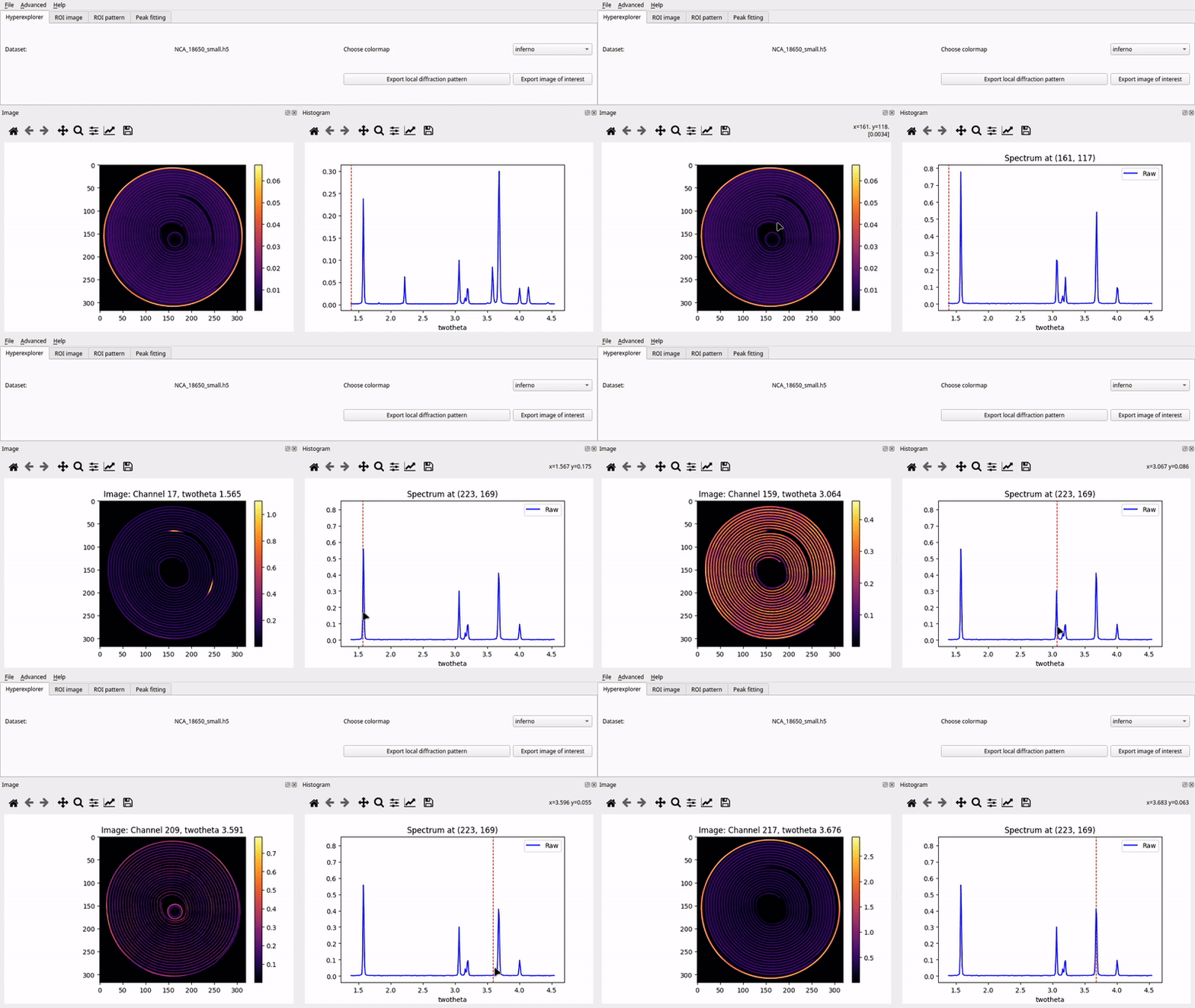
A PyQt-based graphical user interface (GUI) for interactive exploration and analysis of hyperspectral tomography data
A growing collection of simulation tools for generating phantoms and synthetic datasets
The software is designed to be accessible to both researchers and students working in chemical imaging, materials science, catalysis, battery research, and synchrotron radiation applications.
Key Capabilities
nDTomo provides tools for:
Interactive visualization of chemical tomography data via the nDTomoGUI
Generation of multi-dimensional synthetic phantoms
Simulation of pencil beam CT acquisition strategies
Pre-processing and correction of sinograms
CT image reconstruction using algorithms like filtered back-projection and SIRT
Dimensionality reduction and clustering for unsupervised chemical phase analysis
Pixel-wise peak fitting using Gaussian, Lorentzian, and Pseudo-Voigt models
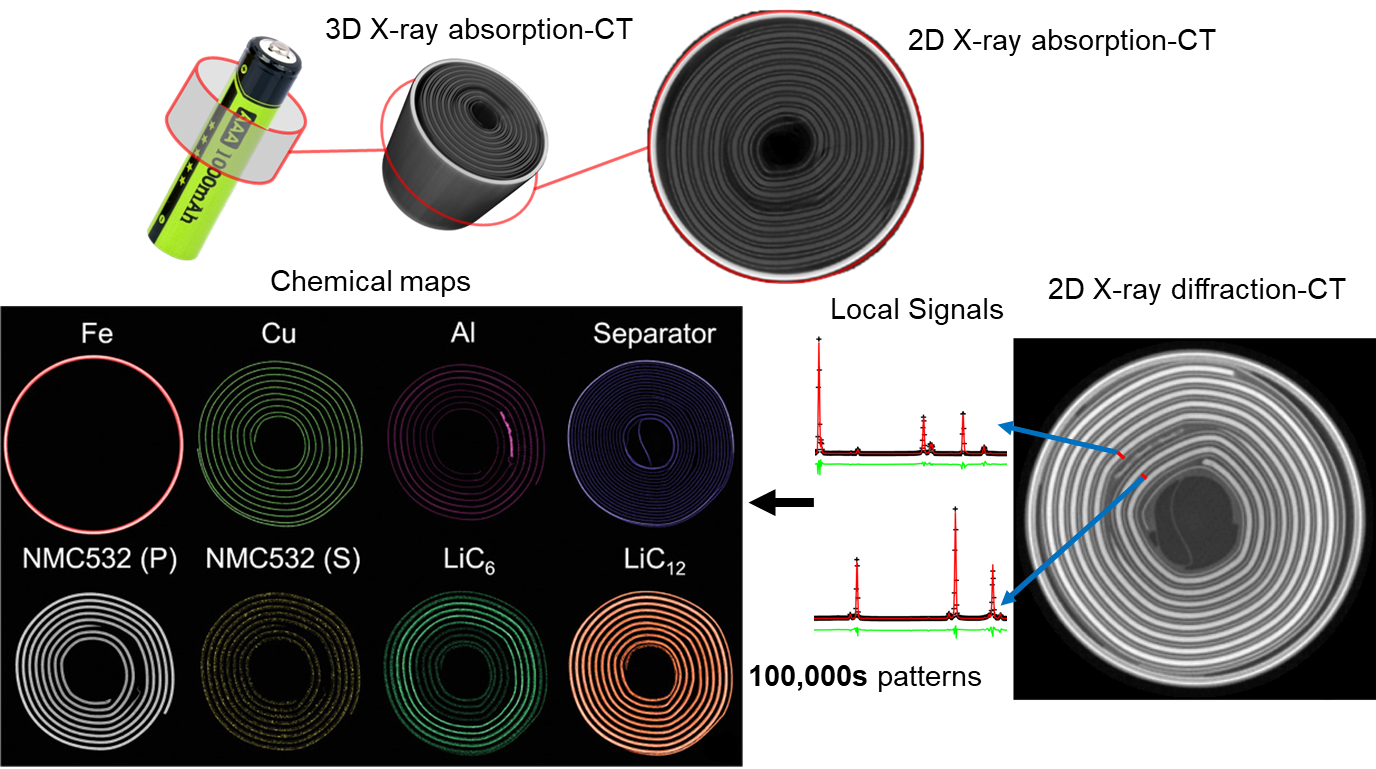
Figure: Comparison between X-ray absorption-contrast CT (or microCT) and X-ray diffraction CT (XRD-CT or Powder diffraction CT) data acquired from an NMC532 Li ion battery. For more details regarding this study see [1].
Graphical User Interface (nDTomoGUI)
The nDTomoGUI provides a complete graphical environment for:
Loading .h5 / .hdf5 chemical imaging datasets
Visualizing 2D slices and 1D spectra interactively
Segmenting datasets using channel selection and thresholding
Extracting and exporting local diffraction patterns
Performing single-peak batch fitting across regions of interest
Generating synthetic phantoms with real reference spectra
Using an embedded IPython console for advanced control and debugging
References
[1] A. Vamvakeros, D. Matras, T.E. Ashton, A.A. Coelho, H. Dong, D. Bauer, Y. Odarchenko, S.W.T. Price, K.T. Butler, O. Gutowski, A.‐C. Dippel, M. von Zimmerman, J.A. Darr, S.D.M. Jacques, A.M. Beale, Small Methods, 2100512, 2021, https://doi.org/10.1002/smtd.202100512